


Crystal Palace becomes the third English club to reach the Conference League final in four years.
Photograph: Richard Heathcote/Getty Images

Aston Villa and Crystal Palace’s journeys to European finals are historic milestones, yet they signal a troubling pattern.
There will be no questioning Unai Emery’s dominance in the Europa League if he lifts the trophy again in Istanbul this month. A fifth title would cement the Aston Villa manager’s legacy and prove his success with an English side. However, that achievement may lose some of its shine. The real worry lies in how Premier League clubs, slowly but surely, are overwhelming Europe’s smaller competitions in ways Uefa likely never envisioned.
Villa will be the eighth English finalist from the last 22 teams to reach the Europa League’s showcase event. Should they win, it would mark the first time since the early years of the Uefa Cup—its predecessor sharing the same trophy—that English clubs have won the secondary tournament in back-to-back seasons. They would build on Tottenham’s chaotic triumph last May, and while consistency or relative excellence should not be dismissed, their progress fuels a broader concern.
Calm Emiliano Buendía provides class amid the chaos to propel Aston Villa into final | Will Unwin
Read more
In south-east London on Thursday night, a jubilant Dean Henderson declared that Crystal Palace “need to get back what we deserve.” It was a reminder of their frustration at being placed in the Conference League after losing an appeal against demotion from the Europa League. Nonetheless, after stumbling through the early stages with key players sometimes held back, Palace proved simply too strong once the decisive moments arrived. Fiorentina and Shakhtar Donetsk, clubs with deep European pedigree, fought valiantly yet were unable to stop them.
If Palace overcome Rayo Vallecano in the final—a matchup that at least pits two traditional big-city underdogs against each other—they would become the third English winners of the Conference League in four years. Two things can be true at once: this is a fairy-tale achievement, in their own context, for Palace to reach this level of continental competition for the first time; it is also the case that even when tripping over their own shoelaces, Premier League teams are fulfilling what their enormous financial advantage has long threatened.
That was never the aim of the Conference League. It was created to give clubs outside the modern elite a realistic shot at European glory in an era when the Champions League—with a few honorable exceptions—remains a gated community. It has certainly provided more opportunities for those sides to compete, though one could argue it also keeps them at arm’s length. Hearing executives from certain well-known clubs, including domestic champions, describe regular Conference League football as the realistic peak of their ambitions sticks in the throat.
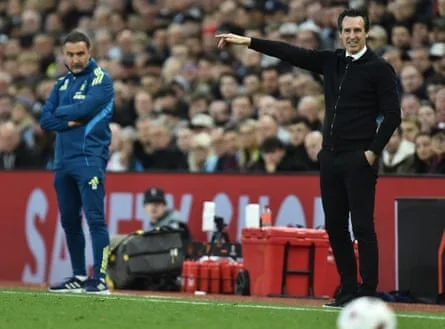
Aston Villa’s Unai Emery could win his fifth Europa League, but his first with an English club.
Photograph: Peter Powell/EPA
Olympiakos’s victory felt closer to an intended outcome, but even that seems like an anomaly two years on. Palace will fancy their chances this time, and a glance at their off-field resources suggests they should: last year, their £200m revenue made them the 26th-richest club in Europe, according to Deloitte’s money league. That is nearly four times the revenue of Rayo, who sit mid-table in a La Liga whose lower tier has been left far behind by Premier League financial power.
One hundred and fifty-two games—188 in the Europa League—and then the English win?
