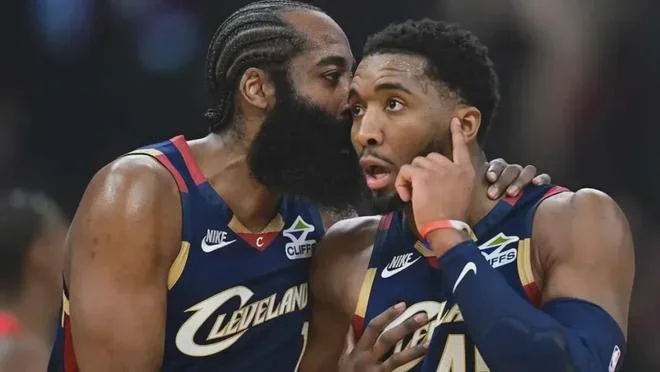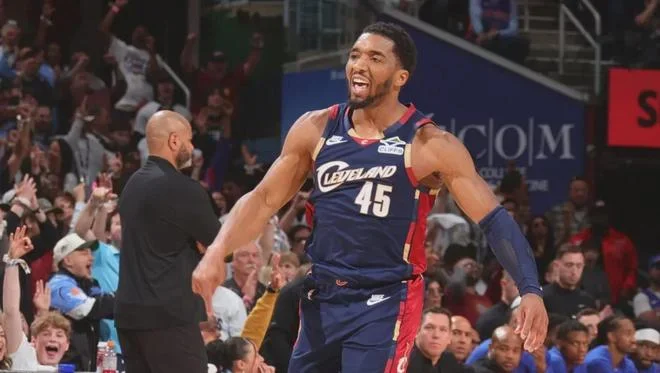

Cleveland Cavaliers played their most complete game of the playoffs so far in Game 4, and Donovan Mitchell delivered his best performance of the series. While Game 3 relied heavily on Mitchell’s third-quarter heroics to keep them alive, Game 4 was different. Mitchell’s explosive scoring turned the Cavaliers’ already strong team effort into a blowout victory, with individual brilliance and collective execution combining for an impressive win.
On paper, the Cavaliers shot just 34.1% from three, with Mitchell, Max Strus, and Sam Merrill combining for 7-of-25 from deep. Only James Harden (5-of-9 from three) looked hot from distance. But the numbers don’t tell the full story. Cleveland’s half-court offense clicked thanks to well-executed pick-and-rolls, drives, and targeted isolation against weaker defenders. The weak-side movement was sharp, and ball movement was crisp, allowing the Cavs to consistently stay a step ahead of Detroit’s defense.
The Cavaliers continued to hunt Duncan Robinson and Tobias Harris in isolation, especially targeting Robinson. Detroit’s protection of these defenders seemed lacking—the Pistons increasingly let Robinson switch onto Harden and Mitchell without sending delayed traps, relying on weak-side help and rim protection that often arrived too late. For Harris, Detroit trusted his one-on-one defense too much, but neither player could keep up with Cleveland’s guards.
After three games of adjustment, the Cavaliers read Detroit’s help defense more effectively. Weak-side players moved intelligently, and passers found the open man. A key tactical shift: playing both bigs with one diving to the rim and the other setting screens worked far better than having Evan Mobley stand on the perimeter to space the floor. Harden’s 11 assists and Mobley’s 5 assists were better indicators of Cleveland’s offensive cohesion than their mediocre three-point shooting. Add Mitchell’s unstoppable scoring, and the Cavaliers’ firepower became impossible to contain.
On defense, the Cavaliers showed clear improvement. The twin towers finally exerted their presence as help defenders, looking dominant at times. For the first time in the series, they made Detroit’s offense feel congested and uncomfortable. This was evident not only during the double-big minutes but also in some single-big lineups, though sustaining that level may be a challenge.
Game 4 was arguably Cleveland’s best performance of the postseason—not in terms of margin of victory or shooting percentages, but in offensive flow and defensive execution. They looked like a team that had fully scouted its opponent and prepared meticulously.
So the big question: Were the Cavaliers just “tanking” in earlier games, or did they simply need time to adapt to playoff basketball before finally putting it together? Either way, they finally approached the level of expectation. Mitchell is playing like his typical playoff self, and Mobley’s performance has gone from “must-execute” to “probation extended.”
Hopefully, this isn’t a one-off.
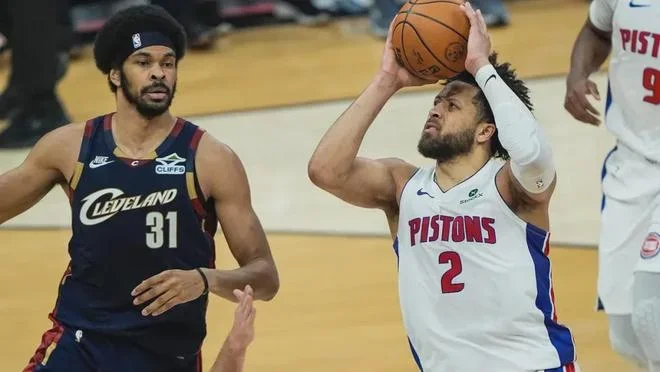
Detroit’s Game 4 struggles boiled down to two main issues:
First, a lack of focus and energy. Jalen Duren failed to look for passes on rolls, and Duncan Robinson and Cade Cunningham didn’t communicate on switches, leaving open shooters. The aggressive, physical defense that defined Detroit earlier was missing—they let Harden and Mitchell drive too easily, then couldn’t recover in time. It was unlike anything they’d shown before.
Second, puzzling turnovers. Beyond basic mistakes like stepping out of bounds, Cade Cunningham surprisingly couldn’t break Jarrett Allen’s traps in the pick-and-roll. Whenever Cunningham tried to use a screen involving Allen, the Cavs big man shut down his passing outlets. Cleveland clearly studied Cunningham’s tendencies, particularly his weaker low-pocket passes, and defended high passes effectively.
For the Pistons, the first issue may be about recapturing energy at home. Sustaining high intensity across seven games isn’t easy. The second issue falls on Cunningham—many turnovers in Games 3 and 4 were avoidable.
Detroit’s bright spots were Caris LeVert and the reliable Naz Reid. Reid continues to outplay Duren in toughness, as noted before. LeVert finally delivered what the Pistons expected from him—consistent scoring off the bench. He had struggled earlier but stepped up when needed. That’s important because Detroit’s second unit lacks wing creators; relying on Jaden Ivey alone is risky. LeVert also gives them a closing lineup option. With Robinson getting targeted on both ends, replacing him with LeVert for better defense late in games made sense.
After four games, both teams have shown their cards. The Cavaliers are learning to use their best players effectively and avoid overplaying weak ones—already an improvement from the start of the series. Mitchell’s resurgence and better adaptation to Detroit’s schemes have shifted the momentum.
Detroit faces a tougher choice. They can’t bench Duren too much just because Reid is playing well—if Duren struggles, it’s on him; if Reid struggles, it’s on the coach. LeVert and Robinson are different archetypes; playing the hot hand is logical but unpredictable.
This series is now even. The outcome is unpredictable, and the suspense is greater than in the other Western Conference series still ongoing (Timberwolves vs. Spurs will be covered after Game 5). Without Victor Wembanyama, San Antonio showed flashes in Game 4 but couldn’t close out. Their three lineup types—Luke Kornet guarding Anthony Edwards, insufficient rim protection, and undersized small-ball—all struggled. Simply put, beating the Timberwolves over 48 minutes is extremely difficult without a high-level interior defender.